How and from whose perspective is history transmitted? How do we talk about colonial history today?
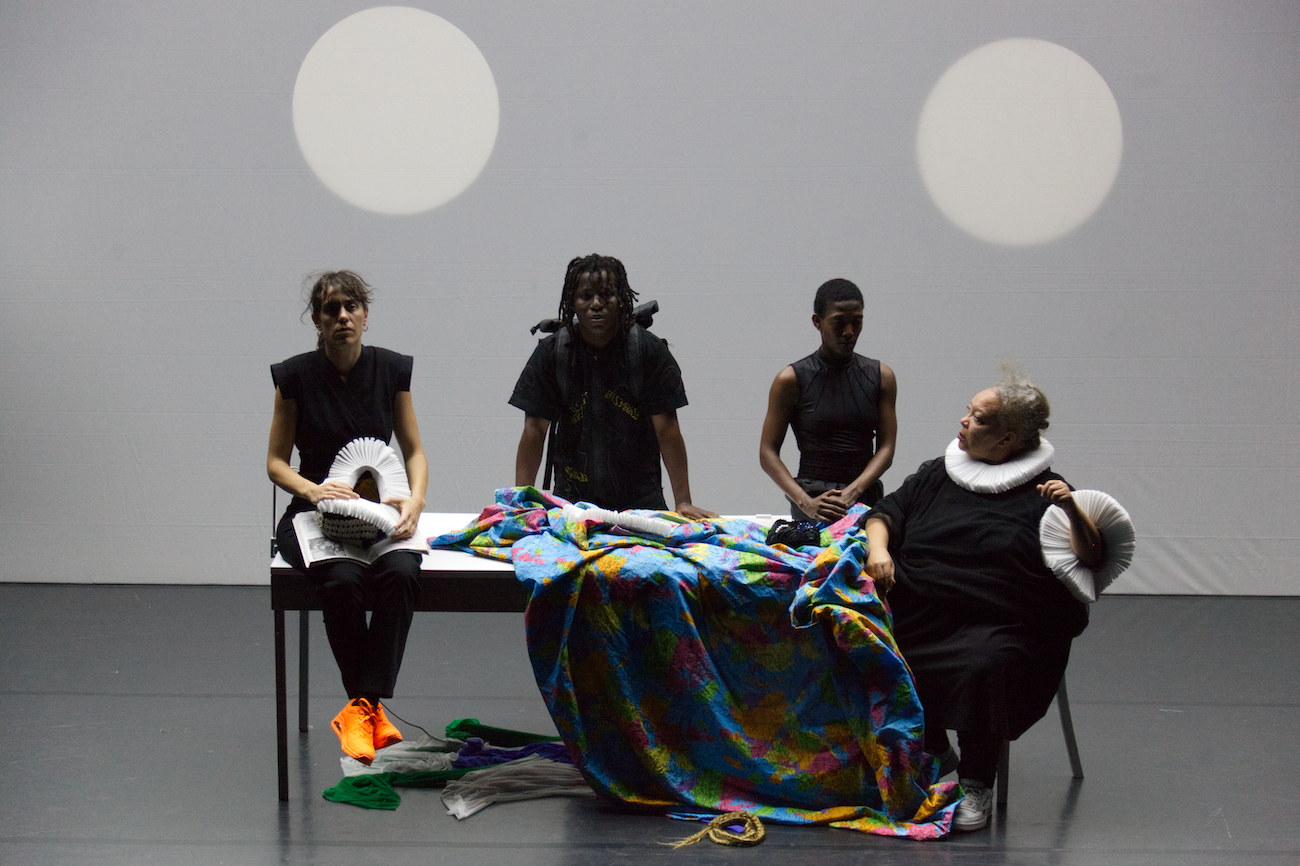
Choreographer Betty Tchomanga takes up the political dimension of theater as a place for transmitting knowledge by setting affects in motion. Unfolding as a kind of history lesson, Decolonial (Hi)stories #Parallel Portraits, brings together four episodes—portraits—through which we discover a colonial history shared by several continents. From France to Benin, Algeria, and Ethiopia, this journey through time and space becomes realized in the stories, dances, bodies, voices, and singular histories of the four performers: Emma Tricard, Folly Romain Azaman, Dalila Khatir and Adélaïde Desseauve aka Mulunesh. Commonalities and differences resonate between their stories, between our stories; unexpected echoes might strike us, unraveling diverse paths for connecting with each other.
Decolonial (Hi)stories #Parallel Portraits brings together the first four episodes of the Decolonial (Hi)stories series.
The work is shown at Moving in November and at Reykjavík Dance Festival through a collaborative curation process. First programmed in Helsinki, Moving in November sends the work to Reykjavík to continue performances.
Born in 1989 from a Cameroonian father and a French mother, Betty Tchomanga began her artistic training in 2004 at the Conservatoire de Bordeaux and with Alain Gonotey of Cie Lullaby. In 2007 she trained at the Centre National de Danse Contemporaine d’Angers (CNDC). As a performer, she has worked with artists such as Emmanuelle Huynh, Alain Buffard, Fanny de Chaillé, Gaël Sesboüé, Herman Diephuis, Marlene Monteiro Freitas, and Nina Santes. Since 2019, Tchomanga has focused on her writing and research as a choreographer. Her pieces explore the notion of transgression in the sense of going beyond, crossing a limit, whether physical or aesthetic. She likes to produce hybrid forms in which bodies transform and metamorphose. She works with practices that involve overcoming the limits of body and mind through intense engagement of breath, body and voice. Since the creation of her solo Mascarades in 2019, she has been researching the voodoo cult and the representations associated with it. She is interested in the narratives that link the West and Africa, particularly through colonial history. Tchomanga’s works include Madame (2016), Mascarades(2019), Lessons of Darkness (2022), and the choreographic series Decolonial (Hi)stories (2023–2026). She is an associated artist at Danse à tous les étages – National Choreography Development Centre in Brittany and Théâtre de la Bastille in Paris.
Alongside her artistic career, she pursued literary studies at the University of Paris, Sorbonne Nouvelle, graduating with a master’s in modern literature in 2014.