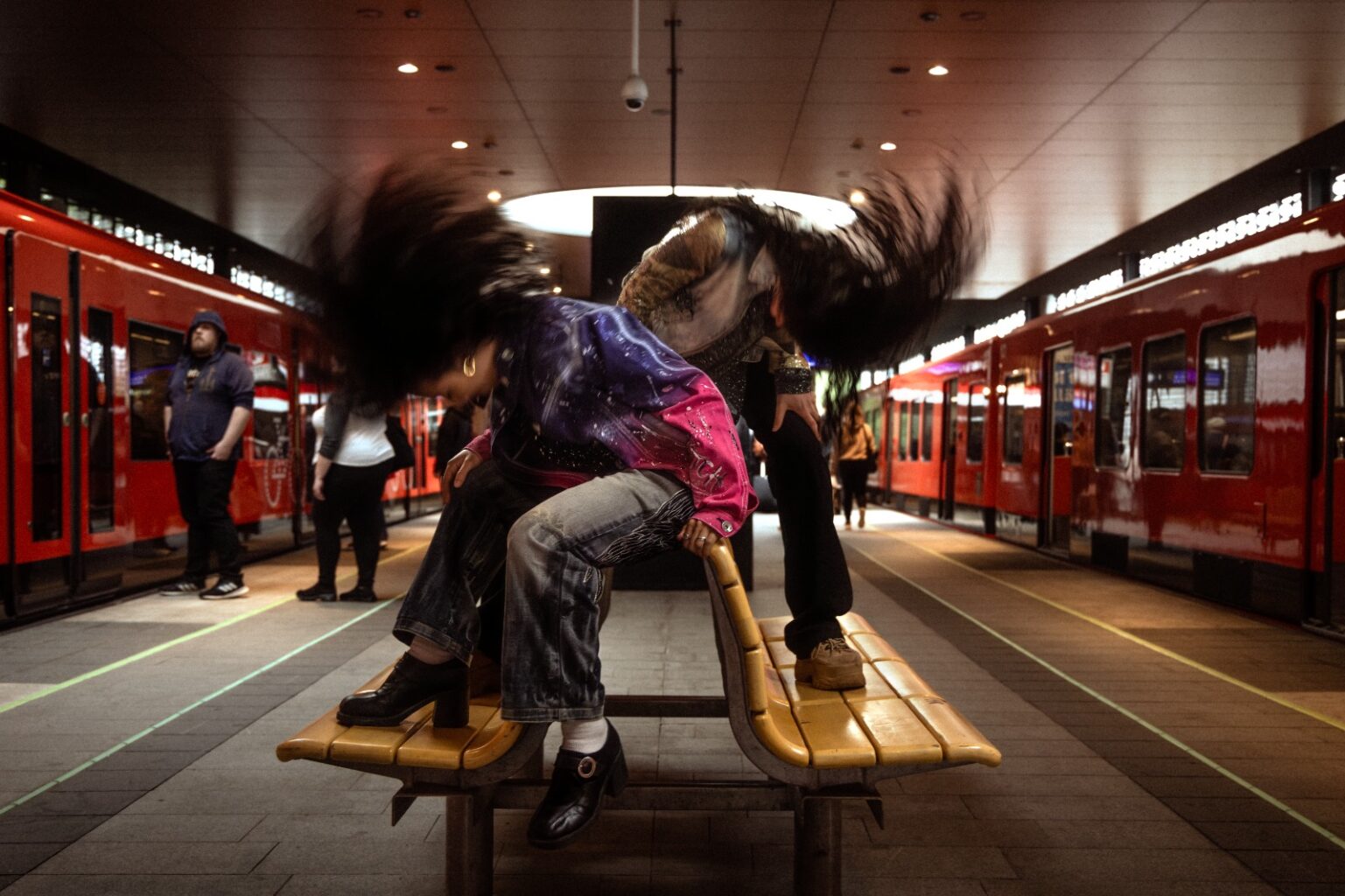
When you told me about the plan to create the performance local guest local ghost, you spoke about the melancholy and joy you observe when entering Finnish karaoke bars. Can you elaborate on this?
During our first year studying together in Uniarts, we were both looking for ways to arrive here, to feel a sense of connection or belonging in this place… and, we were trying to cope with the dark / cold of Finnish winters. We started going to Karaoke together on Monday nights after our classes ended, because we felt that singing REALLY loudly helped us blow off steam; it provided a kind of emotional catharsis that would help us get through the rest of the week. And so often when we walked in the bar, there would just be one or two people there, sitting alone, maybe one of them with a newspaper and beer in front of them… (Somehow there’s always someone sitting alone, reading a newspaper in Karaoke bars? We found this to be already particularly moving, that such spaces activate versions of reality that you don’t see so often anymore…)
So sometimes you experience this practically palpable loneliness, and other nights, the bar is completely packed, there’s an hour-long queue to sing, and people open up, dance, sing, laugh and yell in ways that we had never really witnessed anywhere else here. Is it partially due to alcohol? Probably. But we think there’s a little more to it than that, if only because there is a heightened, energetic quality that comes from performing itself, and karaoke is, legitimately, an unfolding series of very unique performances. This is what inspired us to really nerd out on a performance studies level about Karaoke, because it is a pretty iconic space of contradiction; there’s the possibility of total transformation through voice and body (for about 4 minutes), and also, nobody cares. But we noticed, even if people don’t pay attention to you at all while you’re bearing your heart and soul up there, they almost always clap once you’re finished. Finnish people are very considerate in this way. So there’s this deep sense of support rooted in the entire experience, and also, you’re totally insignificant.
During Moving in November, the performance will take place twice in a karaoke bar and once in a theatre space. How do these different locations affect your understanding of the performance and your preparations for it?
It has been particularly interesting developing a performance for a place where you have almost entirely no control. The other night we were discussing how this is kind of a site-specific work on steroids, because really, what if we show up there, with all of our preparation and costumes and scores and expectations… and there’s already a huge queue to sing? So this has turned us towards researching and working with the inherently performative quality of Karaoke bars, even if you’re not singing – how are you watching? How are you interacting with the space? How are you interacting with other people there, or not? How to create a performance amidst many other people’s performances?
When thinking about the performance at Stoa, where we have a bit more control to shape and determine the environment, we were curious how this kind of unknowing, unfolding dramaturgy, which occurs naturally at Karaoke bars, can find its way into a different version. We’ve been focusing a lot on creating circumstances inside of which we are hosting, flowing between different roles of performers, MCs, Bartenders. This constant transformation of role is very present in Karaoke, so we are staying with that as a way to enter the work. Both of us have experience performing in durational work, but it is an exciting challenge to be both performing and creating it, particularly within the frame of the Choreographic Convention. What if our Karaoke bar is just like, the official bar of the Convention? And then sometimes, it becomes a full-on contemporary dance stage. We’re curious about how quickly or slowly a space or context can shift into something entirely different…
You have both studied choreography at Uniarts Helsinki’s Theatre Academy. I am curious to know more about both of your artistic practices and the way you two work together on this performance.
There’ve been so many beautiful moments so far! We worked together in our very first semester on each other’s “solos”, (particularly in singing together in Chen’s!) and now, having gone through the program / past 3 years, we can really witness how we’ve both changed and grown as makers, and how we’ve stayed the same. There are many commonalities in our artistic backgrounds but also many differences, and they’re somehow both strengthened through working together. We’re very process-based makers, in the sense that we learn about what it is we’re doing through doing it. Often, the things that happen in the room – mistakes, or jokes, or really emotional moments – we add it into the thing itself, then we test it again, we see what happens, maybe we add something on top of it, etc. And then we’re reaaaaaally dependent upon intuition, maybe more than anything else? And for that it’s been special because perhaps we’ve been preparing for this in ways we didn’t even realize throughout the years! We’ve performed in each other’s work, we’ve also been the outside eye for each other’s work, and now seriously diving together into making together, all of that comes through…
And then on a slightly more concrete level, we both have particular practices around ghosts… (Chen’s “visiting” practice, Kadence’s séance sédance practice) I think we’re both very aware of the ghosts that are haunting us, supporting us, challenging us, throughout this work. We are dancing with them in this empty orchestra.*
*(Karaoke means in Japanese, “empty orchestra”)
Chen Amor Nadler & Kadence Luella Neill: local guest local ghost
Sir Oliver 5.11.2026 21:30
Tenkka 9.11.2026 21:30
Stoa 13.11.2026 16–19
Soup Talk 7.11.2026 12:00 @Caisa
Concept, Choreography, performance: Chen Amor Nadler, Kadence Luella Neill
Sound design: The Ghosts
Set design: The Guests
Lighting design (for November 13th): Katinka Ebbe
Costumes: Kadence Luella Neill, Chen Amor Nadler
Co-production: Moving in November
With the support of: Kone Foundation
Photo: Daniel Motola
Thanks to: Ravintola Tenkka, Ravintola Sir Oliver
In collaboration with: Stoa