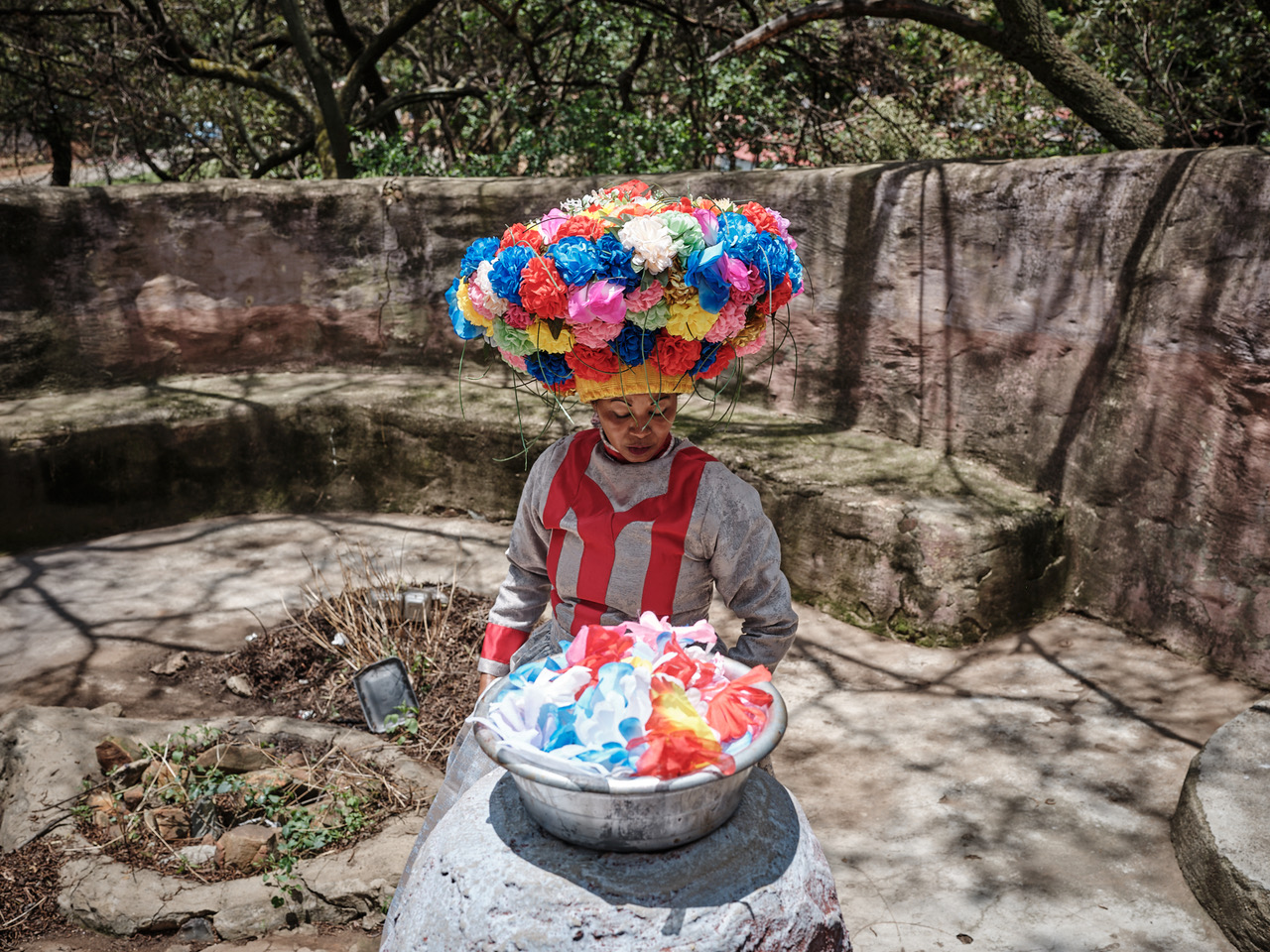
Could you tell us how the idea for this film was born?
deufert&plischke: The idea for RONA grew out of a friendship that began more than 30 years ago. Moeketsi Koena and Thomas Plischke first met as students at the Performing Arts Research and Training Studios (P.A.R.T.S.) in Brussels in the 1990s. The intensity of the training, together with living and working closely alongside each other, created a strong bond between them. After their studies, they went their separate ways and did not meet again for 26 years. Yet, in many ways, their lives continued to develop along parallel paths: both built international careers as dancers, and both have shared their lives and artistic practices for more than two decades with their partners, Gaby Saranouffi and Kattrin Deufert. Both families also have two sons, who have grown up alongside their artistic work and are very much part of their everyday lives.
For around five years, we had been trying to bring the two artistic families together for a collaborative project. Several attempts failed – because of the COVID pandemic, lack of funding, and simply the difficulties of bringing together four artists living and working across continents. Finally, at the end of 2025, we were able to make it happen with Ballroom Bliss Soweto.
RONA emerged organically around the edges of that project. Once we were in Johannesburg, we became increasingly interested in the complexity of Moeketsi and Gaby’s everyday lives: not only their work as artists, but also the relationships, histories, family structures, care, community and ordinary moments that surround their artistic practice. We therefore decided to make the film independently and outside the framework of the original production. Rather than making a conventional documentary about the project, we wanted to create a portrait of a life in which dance, family, memory, politics and everyday existence are deeply intertwined.
In this sense, RONA grew out of the encounter itself. The camera became another way of spending time together and of looking at the lives we were sharing for the first time after so many years apart.
After the filming in Johannesburg, we also realised that this collaboration should not simply end with the film. The experience led us to establish the RONA-collective, with the hope of creating a long-term artistic structure through which these relationships and forms of collaboration can continue to develop.
Gaby Saranouffi: RONA is a powerful documentary born from an extraordinary artistic reunion. After three decades apart, German choreographer Thomas Plischke and South African choreographer Moeketsi Koena reconnect in South Africa, bringing together not only their shared artistic histories, but also their families, children and the communities that have shaped their lives.
Moving between Soweto and Yeoville, the film becomes an intimate portrait of artists beyond the stage—exploring fatherhood, family, friendship, identity, creativity and the responsibility of artists within their communities. Their wives and children, themselves connected to the arts, become part of a wider conversation about how artistic lives are passed between generations.
At its heart, RONA asks profound questions about the place of the artist in South African society. What does it mean to create within a community? How does an artist contribute to the social fabric of the place they call home? And, for women who choose an artistic life in Africa, what does it take to claim their creative voice while navigating tradition, politics, family and society?
Through personal encounters and community stories, RONA moves beyond a documentary about two artists. It becomes a reflection on belonging, cultural identity, resilience and the transformative power of art—and a testament to the communities that nurture artists and are, in turn, transformed by them.
How did you work together with your collaborators on it?
Gaby Saranouffi: For me, RONA was not simply the making of a film; it was a deeply personal and transformative journey. Along the way, what began as an artistic encounter slowly became a shared and almost sacred path—a space where I discovered a new family, built new connections and experienced the extraordinary intimacy of sharing life through art.
What made this experience so meaningful was its organic simplicity. There was no need to force the story. The film grew naturally from our encounters, conversations, laughter, memories, silences and everyday moments. Each participant offered something deeply personal: our stories, our histories, our families, our vulnerabilities and, most importantly, our presence in the moment. The camera became a witness to life as it unfolded rather than simply a tool for documenting it.
This process also gave us something that artists rarely create space for: the possibility of bringing our families into our artistic journey. So often, we create, rehearse, travel and perform while our children remain outside the creative process. With RONA, the boundaries between artist, family and community became beautifully blurred. Our children were not simply observers; they became part of the experience, the conversations and the shared memories we were creating together.
It was a profound pleasure and an honour to walk this path alongside my husband, Moeketsi Koena, our children, Thomas Plischke, Kattrin Deufert, and their children. We were able to meet not only as artists, but as parents, partners, friends and human beings.
For me, this is what makes RONA unique. Its greatest gift was not only the film we created, but the relationships we formed in the process. We shared a piece of our lives with one another, and in doing so, created something that belongs to all of us.
RONA is a testimony to the idea that sometimes the most powerful stories are not constructed—they are lived, shared and discovered together.
deufert&plischke: The film was made through a very collective process. There were five of us working as filmmakers, and more than forty people who became part of the film in front of the camera. We had five main shooting days, with interviews and, importantly, a lot of social time in between. We spent time together in different places in Johannesburg – or Jo’burg, as many people call it – that are meaningful to Gaby Saranouffi and Moeketsi Koena and to their lives.
Although we discussed and planned all the scenes beforehand, the reality of filming in Johannesburg constantly challenged our plans. The local circumstances, the people we encountered, the atmosphere of a place or simply what happened that day often wrote their own script. We had to remain open, improvise and make decisions together in the moment. This became an important part of the collaboration: gradually, we developed a strong trust in our shared judgement. At different moments, anyone could take the lead, depending on what the situation required.
It was also important for us to involve many people from Gaby and Moeketsi’s lives – friends, colleagues, neighbours and people they have known for many years. We did not want the choreographic scenes to exist in isolation, but to have a social and political dimension and to be connected to the communities in which they take place. In particular, the women we met in Yeoville and Soweto brought perspectives and experiences that became an essential part of the film.
One of the central places in the film is Bapedi Hall in Soweto, where Ballroom Bliss took place. The Ballroom became much more than simply the setting for a performance. It brought together many of the people, histories, energies and forms of community that the film is interested in. In that sense, the Ballroom itself became one of our collaborators.
You often work with communities, also creating rooms, places, spaces to make encounter and encounters possible. Could you tell more about your interest in this?
deufert&plischke: For us, every new gathering of people holds a singular promise. Every constellation is different, and therefore every encounter can produce something that could not have been produced by another group. This is both inspiring and challenging, because it means that we cannot simply rely on established processes, fixed ensembles or the authority of a dominant artist. We have to listen, adjust, negotiate and reinvent the conditions of working together.
This is why creating spaces for encounter has become such an important part of our artistic practice. We are interested in what happens when people who would not necessarily meet otherwise are brought together around a shared question, a shared activity or simply the possibility of spending time together. The space we create is not meant to determine what will happen. Rather, it should allow something unexpected to emerge.
Working with communities has therefore constantly challenged us to rethink our own practices. It has made us question who gets to speak, who is visible, whose knowledge counts, and who has the right to shape the situation. We have learned that collaboration is not simply about inviting people into an already existing artistic process. It can also mean allowing the process itself to be transformed by the people who enter it.
In this sense, we see these encounters as a form of artistic research. They are also a way of thinking about how we want to live together. Dance, film, conversation, cooking, gathering or simply sharing time can become ways of producing knowledge collectively – knowledge that does not belong to one person, but emerges between people.
This is particularly important to us when working across different cultural, geographical and social contexts. We do not want to arrive with a method that can simply be applied somewhere else. Every place asks us to reconsider how we work. The local context, the people we meet, their histories and their ways of organising life together become part of the artistic process.
Perhaps this is also why our work with communities keeps our practice alive. These processes are never entirely ours to control or to own. They continually point beyond the individual artwork, towards relationships that may continue after the project has ended, and towards forms of shared futures that we can only imagine together.
For us, creating a space for encounter is therefore not simply about bringing people together. It is about creating the conditions in which something can happen that none of us could have made alone.
Gaby Saranouffi: Our organization, ITROTRA ART X CONNECTION, is rooted in the heart of Soweto, and our work begins with a very simple but powerful belief: the arts must be accessible to everyone, regardless of where they come from or their circumstances. Our motto is “Arts for Excellence for All.”
Being based in Soweto is not simply a geographical choice for us; it is fundamental to who we are and why we exist. We believe that communities should not only be audiences for the arts—they should be active participants, creators, artists, cultural leaders and beneficiaries of the opportunities that the arts can provide.
Our first responsibility is therefore to serve and respond to our community through culture. We organise and curate dance festivals, develop artists through training and mentorship, create opportunities for professional development, and build platforms where emerging and established artists can meet, exchange knowledge and present their work. We are particularly committed to taking high-quality artistic experiences into communities that are often underserved and under-resourced.
We see the arts as much more than entertainment. Art can educate, empower, connect and transform. It can give young people a voice, create pathways for artists to develop sustainable careers, bring generations together and open conversations around issues affecting our communities.
Through our programmes, we create spaces where people can encounter excellence without having to leave their communities to find it. At the same time, we create opportunities for artists from these communities to connect with national and international networks, exchange ideas and position themselves within the broader professional arts landscape.
For us, professionalisation is also important. Talent exists everywhere, but opportunity does not. Our role is to help bridge that gap by providing access to knowledge, skills, platforms, mentorship and artistic networks.
Ultimately, ITROTRA ART X CONNECTION is about creating connections through art—between communities, artists, generations and cultures. We want to demonstrate that excellence and access do not have to be opposites. Our vision is a South Africa where every community can experience, participate in and benefit from quality arts and where artistic potential can become a meaningful pathway to confidence, opportunity and transformation.
Arts for Excellence for All is not simply our motto; it is the principle that guides our work.
Gaby Saranouffi, deufert&plischke, Moeketsi Koena & Thabiso Heccius Pule: RONA
Kino Caisa 12.11.2026 17.00
Soup Talk 12.11.2026 18.00 @Caisa
2026 (ZAF, DE)
Single-channel video, colour, sound
By: Gaby Saranouffi, deufert&plischke, Moeketsi Koena, Thabiso Heccius Pule
Production: I’Trotra Art X Connection Johannesburg / deufert&plischke – spinnereischwelm / dpsp studio Schwelm with the kind help of Goethe Institute South Africa.
Co-production: Pina Bausch Centre under construction, Wuppertal Ballroom Bliss Soweto was supported by the Ministry of Culture and Science of North Rhine-Westphalia as part of the Export Promotion Programme 2025, with the kind help of Goethe-Institut South Africa
Photo: deufert&plischke
Visit in collaboration with: Caisa
Soup Talk supported by: Goethe-Institute Finnland