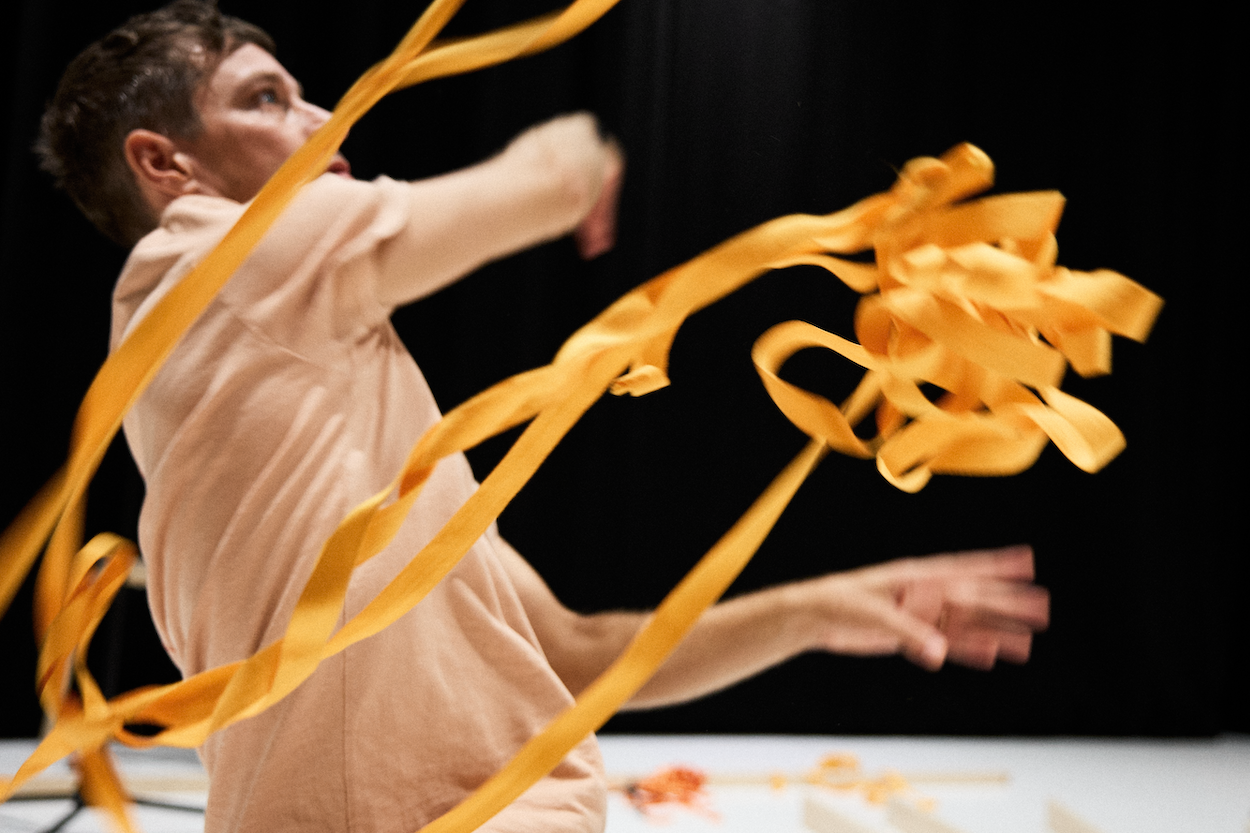
You worked together with the Dance Company Off/Balance on this performance. What was the starting point, and how have you worked and collaborated together?
I was very inspired by the essay collection Vesper Flights by Helen Macdonald. In the essays she writes about the natural world and the relationship human beings have with it. The essays deal with loss, destruction, grief, but also hope. There is an attempt to understand the world we live in and an immense amount of respect and care towards the natural world. She writes: “To understand that your way of looking at the world is not the only one. To think what it might mean to love those that are not like you. To rejoice in the complexity of things.”
For our work I had the idea of creating two versions of the piece; one outdoors and the next one indoors. The first piece was intended to be a walk together with the audience and the latter a stage performance. It took us a long time to find the resources for the work and thanks to the persistence of Off/Balance we got to do them both. The first installation/outdoor performance was realized in 2023 in Jyväskylä. The indoor installation piece we show now in Moving in November, premiered last autumn in Tanssin Aika Festival in Jyväskylä.
I had free hands to invite all the collaborators and the project ended up being not only under my name finally. We worked very closely together with visual artist Salla Salin, sound designers/musicians Paul Valikoski and Tatu Rönkkö, and then alongside with Elina Häyrynen from Off/Balance, we have Anna Virkkunen coming from the field of dance. The input and information from ornithologist Mia Rönkä has been key for the work. This is very much a work of all these people even if I brought the first drafts of the concept on the table.
We have worked in a different way than I would work when creating a piece on stage with main focus on performers. Here we had first the information from Mia, then came the elements from Salla, Paul and Tatu and only after that the physical actions. We were able to work on the dramaturgy of the piece only after the others had contributed a lot to the project. I love this shift in the way of working. The other elements inform the actions, and they are almost more prominent in this work. The piece is a lot about the atmosphere of the space and guiding the spectators to use their senses, especially the sense of hearing.
After having done the outdoor version and after we had been working in the forest, it felt like we can’t fill up the space with too much focus on the performers. Outdoors our role was to guide the spectators to observe the environment, to tune into the forest and to notice small details. We have tried to bring similar thinking indoors.
I am curious to hear how you arrived at the title for this performance.
In the title essay Vesper Flights Helen Macdonald talks about the evening flights the swifts make. When the sun sets, they ascend very high to collect intel and reorient themselves to the world. Our title “In the Waning Light” refers to this and also to the autumn season when the amount of light starts to wane, and the birds migrate south. The bird migration has been another key aspect of the work and Mia Rönkä, the ornithologist we have been working with, has been informing us about the scientific aspect of the migrations. It is absolutely fascinating to listen to her share the knowledge she has about birdlife. Helen Macdonald on the other hand talks a lot about what us humans could learn from nature. Her writing has been with me for a long time, and I keep returning to it in other projects as well.
Originally the outdoor installation was planned for the autumn, sort of as a last summer celebration. We did another version of the walk in the spring 2024 and Mia for example adapted her text to this and focused more on the arrival of the birdlife rather than the autumn migration. There we retitled the piece “In the Soaring Light”. The project keeps evolving depending on the time of the year when we share it with the spectators. Now we will perform in November, and I am curious to work on the beginning text with Mia since November is a very different moment in the cycle of the migratory birds than August or May.
From an ornithological perspective, In the Waning Light II explores departure, disappearance, and loss—themes found and present in nature. Could you tell more about this?
I find autumn very melancholic; the departure of the birds, the waning light, and the growing silence. How long will it take until next spring, and will the more colourful and louder life return? With Mia we have discussed the effect of climate change on birds. We have spoken about that in the context of the unknown; how it will be next spring, which species return, in which numbers, and how this will develop in the future. I quote Helen Macdonald again: “writing about love means you are also writing about death. Because love and death and loss are all part of one thing, really, particularly now with the climate emergency. It is really hard to write about the natural world without writing about grief.”
All those elements; departure, disappearance, and loss are continuously present in nature. Not only in relation to climate change of course. The cycles repeat, transform and evolve. Our main focus was on migratory birds; the way they orient in the world, their life cycle, how they function in a flock, the roles they have and how they ensure the survival of one another. In the essays Macdonald is asking us to rethink our roles as human beings. How do we function as a community and how do we ensure the survival of the other?
In the performance we attempt to balance with these topics. The installation is subtle, playful, melancholic, loud and silent and I am looking forward to share the work with all of you this November.
Koistinen, Rönkkö, Salin & Valikoski: In the Waning Light II
TSC Studio, Cable Factory 13.11.2026 15.30 / 14.11.2026 16.00
Soup Talk 14.11.2026 12.00 @Eskus
Concept and direction: Milla Koistinen
Choreography and performance: Elina Häyrynen, Anna Virkkunen, Milla Koistinen
Sound design, music, and performance: Paul Valikoski, Tatu Rönkkö
Spatial design: Salla Salin (partly recycled materials from the work Say Surrender, Stay, spatial design by Ins Meyer)
Costume: Maria Sirén
Ornithologist: Mia Rönkä
Texts: Mia Rönkä, Helen Macdonald
Production: Dance Company Off/Balance, Milla Koistinen
Visit co-produced by: Dance Company Off/Balance in collaboration with Tero Saarinen Company and Moving in November
Residency: Tero Saarinen Company
Photo: Ilkka Saastamoinen
Supporters: Arts Promotion Centre Finland, City of Jyväskylä, Finnish Cultural Foundation, Keski-Suomen Tanssin Keskus