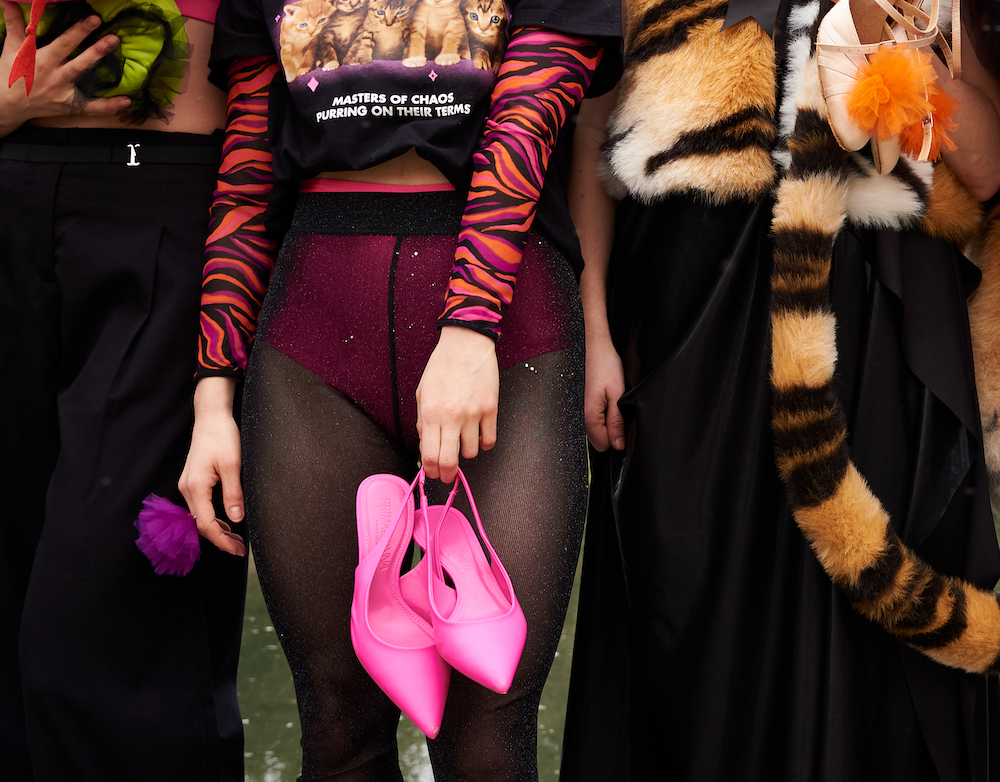
BODY SWEATS (for Elsa) is a homage to Baroness Elsa von Freytag-Loringhoven. What drew you to her? And why were you interested in looking back at the Dada movement?
This story starts in Berlin, maybe a year and a half ago. I saw a theatre piece on Kurt Schwitters’ Ursonate and for the upcoming days kept thinking about everything that I liked about Dada: the questioning of structures and the reinvention of rules. The associative nature of Dada thinking appeared to me so contemporary and resonant to the fragmented reality that social media algorithms curate for us.
I started looking more into what Dada-dramaturgies could look like. When you google “dada”, you get a lot of male artists. Art history is a realm of the patriarchy and pushes the idea of the male-artist–genius. But like in any other archive, one might need to dig a little deeper to find other narratives. And there I met Elsa (like it happens every so often, online). I fell in love three times: with the picture of her standing on one leg we show at the beginning of the performance, with the sharp handwriting of her autobiography, and with her poetry—archived by her editor (and we like to believe her untold lover) Djuna Barnes.
Elsa was born in 1874 in Swinemünde—now Poland. She moved to Berlin at the age of twenty. Thanks to her ambiguous charm and unscrupulousness, she earned a living as an actress and model for erotic sculptures. For her, performances were an opportunity to showcase herself, to meet men who would help her cope with poverty and became the object of systematic and compulsive sexual experimentation.
In 1903, she fell in love with a friend of her husband, and in 1906, after helping him stage a fake suicide, they fled to Canada, then Kentucky and Cincinnati. After much wandering, she arrived in 1903 in New York, where she married Baron Leo von Freytag-Loringhoven (that’s where her flamboyant “Baroness” title comes from). Wrapped in velvet and adorned with jewels, teaspoons used as earrings, stamps glued to her cheeks, a birthday cake instead of a hat: Elsa went down in history for her desire to turn her body into a work of art, anticipating performance art by at least forty years.
Elsa’s life is one of flamboyance, excess, decadence, rage, pleasure, emancipation and reinvention in the city. I thought it was a story worth responding to, and gathered the working group around this affection. With our dances, instead of trying to tell Elsa’s story, we asked one another what resonated with it: how can we make a dada soirée? What other Baronesses do our genealogies hide—personal lives, dance history, pop culture? And lastly: can I find the courage to wear that outfit?
Her story is an inspiring reminder, although a harsh one (she died alone, in poverty, probably suicidal), of the fact that freedom is not a given and is never achieved once for all. It is rather a negotiation within oneself and the communities we are part of, a continuous act of resistance against fear, with its frictions, inconsistencies, small victories and often greater falls. We try to share with the audience the biggest teaching from Elsa’s Dada: not being scared of failing miserably, and blurring the faint boundaries between Art and Life. A reminder that life’s choices can also be made—more joyfully—to the discordant sound of an unapologetic shout for freedom.
In a conversation the other day, you told me about your dream of having a dance company. Could you tell us more about this dream and what drives this urge?
Much like the Baroness, I am a girl from the countryside. During the nineties, in Italy, boys played football and girls went to dance classes. I started ballet at the age of 5 and grew up in a pink (but also queer) world, watching dance companies twirl on the beautifully steep and golden Italian theatre of my hometown, Reggio Emilia. Yet, as a kid, it has always been pretty clear to me that I would not become a ballerina. Later on, as a professional, my experiences within dance companies were short and bittersweet. The friction with poorly run hierarchies and nodding a quiet “yes” to the abuse of power from (male) directors was too much for me.
Choreographic work has taught me that dance doesn’t have to be a failed dream: now I get to wear a tutu and perform on big stages. And I hold tight to the belief that dreams are incredibly more fun when we share them with people we love. Dance (like everything in this turbo-capitalist nonsense we live in) is pushed to be an individual pursuit. With my work, I try to create the conditions for people to go back to dancing for joy and the child-like thrill of performing. And on stage, as dancers, we recognise one another: I am still with my friends from kindergarten making performances in living rooms. We were—and are—comrades within shows of make-belief where glitter becomes the cheap magic to unlock world-making potential.
Maybe from re-creating those conditions there is a space to rethink the structure of what dance companies can become in the “contemporary world”. Something I frowned upon so much and I am now questioning: what can we keep from what is inherited from the past? I like to think that—rethinking an ethical leadership—we can save the value of comradery and theatre-making as a collective project.
BODY SWEATS (for Elsa) has been developed in co-creation with dancers Vittoria Caneva, Elena Grappi, and Maria Chiara Vitti and off stage, the dialogues with Italian dramaturg Piero Ramella, Estonian costume designer Eva-Liis Lidenburg and Finnish sound designer Sebastian Kurtén. I can see this being the company we are talking about —but for now we are stuck at stage one: choosing a name.
You are working both in Italy and Finland. How do you see your work as an artist in relation to these two countries?
I get this question in nearly every conversation, and I always end up giving a different answer. I am from Italy, but I also left at 18. I am both here and there. My work maybe is a container for all this complexity: a good reminder that two things can be true at the same time. That you can be a “local artist” and fly in people to bring the work to stage.
My productions end up looking more like cross-national complications, but I find a lot of richness in keeping Italy and Finland communicating. They really are at the opposite sides of the continent, geographically, culturally and aesthetically. I know that the flamboyant and visually abundant costumes – of Tallinn-based designer Lidenburg – are quite unseen in the South. And that my love with ballet might be oddly vintage in Helsinki. When we have performed in some small Italian cities, reviewers have written about our hairy armpits and lack of hairspray. I smiled 🙂 maybe this performance work is really not for nothing. I sense a cultural fabric for which it is needed to take up space as women – centre stage, being loud and showing skin if we want to – particularly in the political climate Italy has lived in the last few years.
I am very privileged to have travelled quite much during my education, but often I feel out of place in both countries. A lot of my work as a choreographer nowadays has to do with creating the conditions for people to gather. We might live far away, but there is so much potential in sharing space and time in the studio.
That’s really what the work of a company seems to be about, to me.
Giorgia Lolli: BODY SWEATS (for Elsa)
EMMA – Espoo Museum of Modern Art 14.11.2026 15.00 / 15.11.2026 15.00
Soup Talk 7.11.2026 12.00 @Caisa
Choreography: Giorgia Lolli
With: Vittoria Caneva, Elena Grappi, Maria Chiara Vitti, Giorgia Lolli
Costumes: Eva-Liis Lidenburg, Sara Lando (tiger)
Sound work: Sebastian Kurtén
Dramaturgy: Piero Ramella
Production: Nexus Factory
Co-production: Moving in November
Supported by: MiC Italian Ministry of Culture and SIAE, within program “Per Chi Crea”, supportER – Rete Anticorpi Emilia-Romagna, Nouveau Grand Tour (IIC di Parigi and Le Gymnase CNDC), Operaestate/CSC Centro di Residenza del Veneto – Vene.Re, Piemonte dal Vivo in the frame of Residenze Coreografiche Lavanderie a Vapore, I Teatri di Reggio Emilia, Ira Institute, Home 2025 / Dance Gallery Perugia, Culture and Youth Committee of the City of Espoo, Arts Promotion Centre Finland, SKR Finnish Cultural Foundation, Graner (Barcelona), MOVIN’UP SPETTACOLO – PERFORMING ARTS 2025/2026, Emilia-Romagna Region, Municipality of Bologna
Within LANDING, a project supported by the Italian Ministry of Foreign Affairs and International Cooperation and carried out by Santarcangelo Festival, in collaboration and with support of the Italian Cultural Institute in Oslo
Residency presented within the network R.O.M. (Residencies On the Move) for Reykjavik Dance Festival, at the invitation of Santarcangelo Festival, in partnership with La Balsamine (Belgium), le joli collectif – Théâtre l’Aire Libre (France), Théâtre Prospero and Théâtre Periscope (Canada)
The network R.O.M. is supported by the European Union through the Creative Europe programme, by the Conseil des arts de Montréal and by the Conseil des arts et des lettres du Québec
Photo: Hanna Kushnirenko
Visit supported by: Crossing the sea project, Culture and Youth Committee of the City of Espoo
Visit in collaboration with: EMMA – Espoo Museum of Modern Art