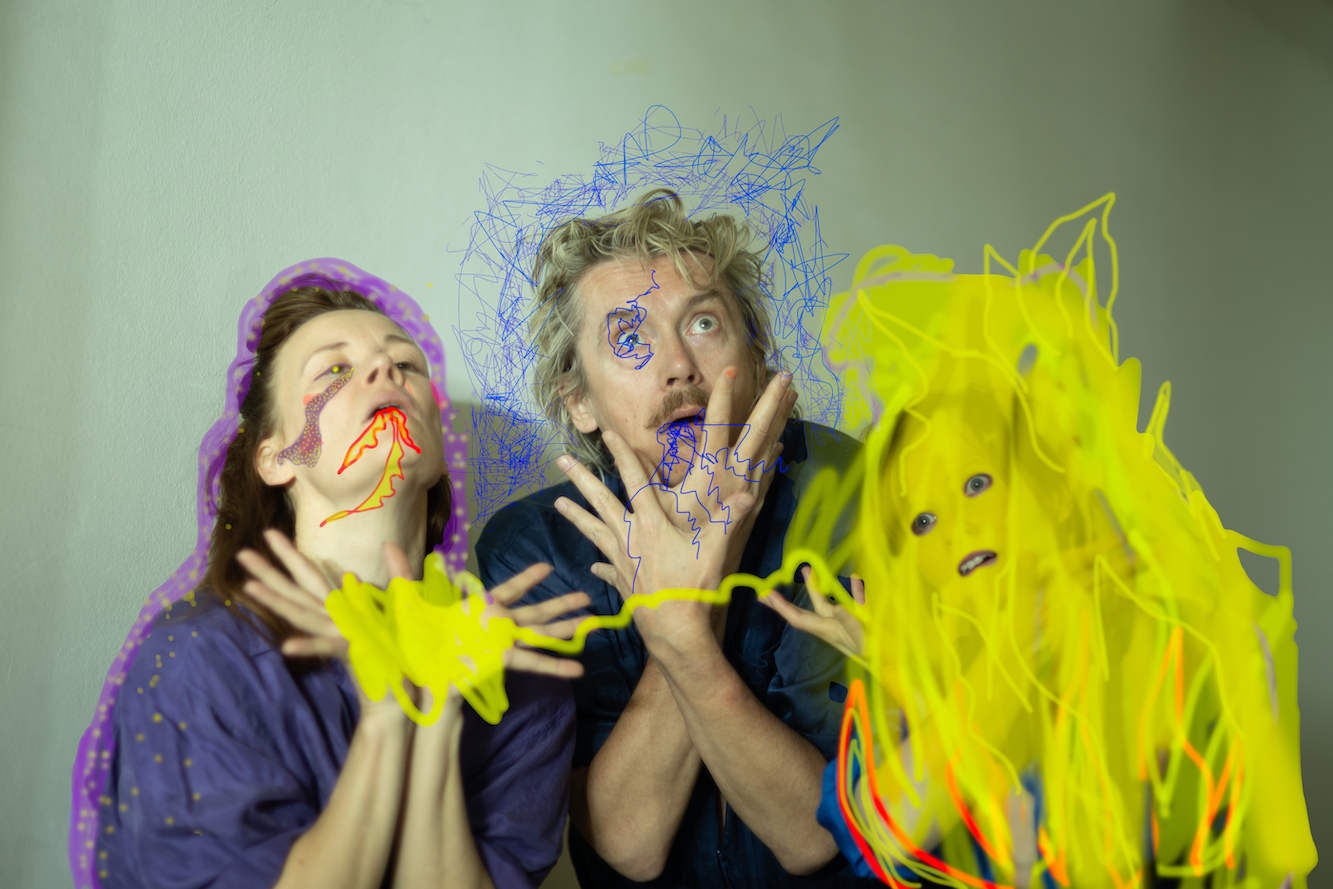
In Writing of Disaster, an adaptation of Maurice Blanchot’s The Writing of the Disaster, you are working on joy and tragedy. Could you tell us about the desire to create this new performance and your work with Blanchot’s philosophical text?
My desire to work on this performance comes from a long-term need, passion, and interest in dealing with incomprehensible topics on stage. The Writing of the Disaster, as a beautiful philosophical book full of paradoxes, works for me as a kind of resonance for creating choreography.
For me, the core of the book may lie in its attempt to deal with the experience of a certain radical emptiness in our existence—something that we can never quite describe, comprehend, or write about. We need to admit that our subjectivities will never fully comprehend certain disastrous forces existing in the present, in history, and in our lives. The book leaves us facing the fact that we are small.
For me, the book is also inspiring in relation to performance as an event. I can relate performing to facing a kind of disaster. Our body is a living organism that is constantly getting older—as Blanchot says, in a sense, already dead from the moment we are born. I think it is artistically interesting to try to face that fact: to face an emptiness that is at the same time terrifying and enjoyable.
And from there, of course, comedy and ridiculousness also emerge. So why not both tragedy and joy?
You developed this performance with Hanna Raisinmäki and Jyrki Karttunen. How have you worked together on it?
This work has very much been created through specific performative practices, where the performers contribute a lot of themselves and allow their own energies, tendencies, and ways of being to vibrate through the work. For me, the work is very much about the depth and miracle of each performer, and about their individual bodily universes and intelligence.
It is a privilege to work with them, because they are both enormously experienced performers and artists. We also share a long history with each other in different ways. This shared knowledge resonates deeply in the work. We don’t have to start everything “from the very beginning.”
Of course, all the designers have also brought their input into the process from a very early stage.
Because the philosophical book is our common source, we have created different methods for sharing the material: reading the book together and separately and allowing the material to resonate in different ways. This has felt important, because it gives each performer and designer the possibility to act and use their agency in a very wide associative field, and then to navigate the common field that starts to emerge.
Then we can also be brave enough to almost forget the source and see what we have got.
Your performances are often very humorous—even absurd. I am curious to understand how you look at the notions of humour and absurdity in the performing arts and in your work.
I guess I tend to resonate with humour because it helps me navigate and follow moments on stage when the body starts to lose control in an interesting way. The fact that something starts to become funny can also relate to a performer, for example, fully trying to deal with a complex task on stage and concentrating intensely on it.
My biggest interest as a choreographer, and usually also as a spectator, is to witness some kind of “event” in performance. When it comes to live art, I think the most interesting aspect lies in the unpredictable things that happen between the makers and the audience. As a choreographer, I notice that I try to create circumstances for such an event to happen. Humour is often related to that.
It is about sensing the audience, trying to open holes between the stage and the spectators, and communicating through a more bodily experience.
I feel that humour is also a huge risk as a genre or direction in performance, because sometimes it simply doesn’t happen, or it dries out. It is also one of the most difficult tasks for a performer to try to be funny. That is why, for me, it is important that the concentration lies somewhere else. If the comedy happens, it happens as an effect, or as a kind of surplus.
Humour is also a risk in a wider way within the context of contemporary dance. The unpredictability of laughter can be scary, because it means that we come closer to our strange incorporeality. I feel that in art, too, surprisingly enough, our bodies—and the universe that emerges through bodily feeling and sensing—are becoming increasingly distant.
Humour and laughter are perhaps a way for me to connect with the body again.
Jenni-Elina von Bagh: Writing of Disaster
Teater Viirus 6.11.2026 18.30 / 9.11.2026 18.30 / 11.11.2026 18.30 / 12.11.2026 18.30
Soup Talk 10.11.2026 12.00 @Caisa
Choreography and concept: Jenni-Elina von Bagh and the performers
Performers: Hanna Raiskinmäki, Jyrki Karttunen, and Jenni-Elina von Bagh
Set and costume design: Ingvill Fossheim
Set design: Virpi Nieminen
Lighting design: Ina Niemelä
Sound design: Tatu Nenonen
Dramaturg: Otto Sandqvist
Producer: Lisa Kalkowski
Promoter: Harri Kuorelahti
Supporters: KUVI/Taike, Svenska Kulturfonden, City of Helsinki, Kone Foundation, Teisko radicalization residency, Moving in November
In collaboration with: Teater Viirus