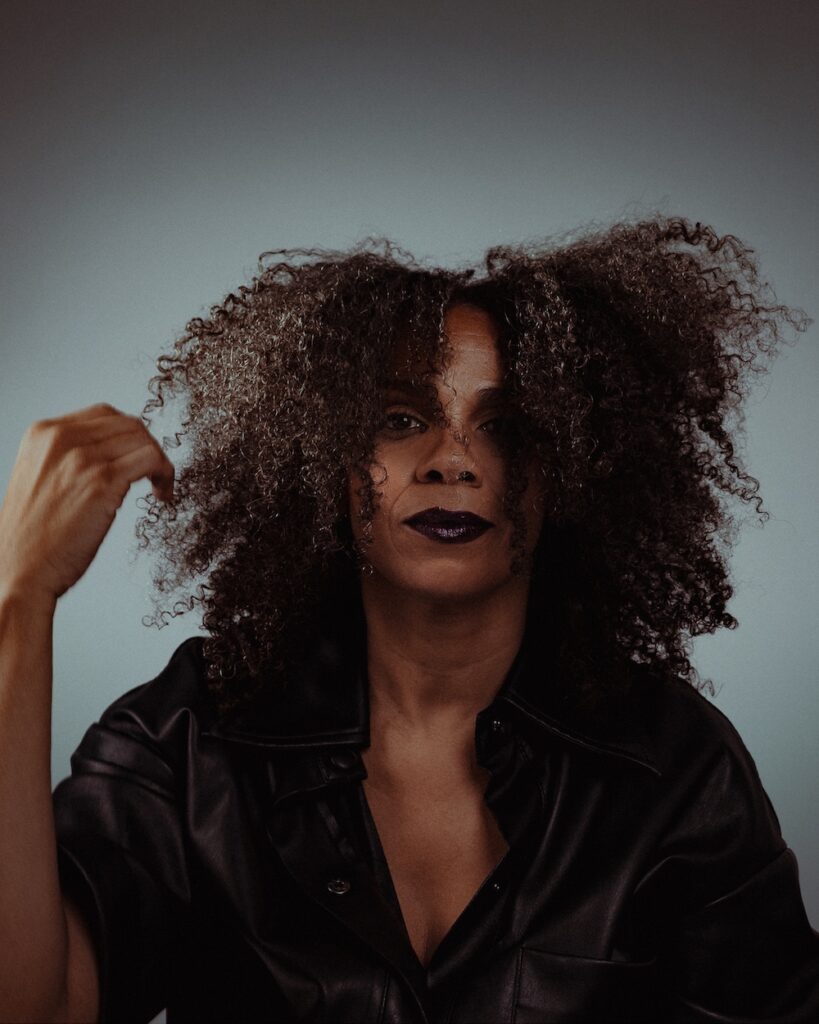
Mélanie, could you tell us about the desire and background behind creating Confession Publique?
Confession Publique came from a question that has followed me for a long time: what part of ourselves becomes public the moment we step onto a stage? As performers, we often believe we can hide behind a role or a choreography, but audiences are always reading something beyond that. They read our age, our stories, our history, our vulnerabilities, our desires. They read our bodies as biographies.
I first imagined it as a solo for myself. Then life happened—in the form of a pregnancy. I had to put the project away until Angélique Willkie came to me, asking me to create a solo for her as part of her doctoral research. What I had thought was deeply personal material suddenly resonated with the questions she was exploring. At the heart of both was the same inquiry: what is the dramaturgical weight of the performer?
I’ve never been interested in confession simply as revelation or strip tease. I’m interested in the choreography of confession, its catharsis. How we decide what to expose, what to conceal and how that negotiation shapes who we become.
The work emerged during a period where I was questioning my own position as a choreographer. I realized that I don’t choreograph movement as much as I write bodies. I write from the body. The body carries memory before language does and dance allows us to access truths that cannot always be articulated.
In Confession Publique, the confession never fully arrives. It is constantly improvised, recreated, sometimes postponed, interrupted, displaced. What fascinates me is not the secret itself but the tension between intimacy and public exposure. The theatre becomes a place where private experience is transformed into a shared, collective space without ever becoming anecdotal.
Ultimately, the piece asks a simple question: How much of ourselves belongs to us once we decide to be seen?
You worked on this performance together with Angélique Willkie—a solo for her, almost—yet there is a second person on stage. How do you perceive their relationship, and when did this third person, Anne-Marie Jourdenais, came into play?
I never imagined Confession Publique only as a portrait of Angélique. It is certainly built around her extraordinary presence, her intelligence and her generosity, but I was also interested in creating multiple links between her story and the collective history of colonialism, feminism, oppression, race, migration, Black bodies, etc…
What interests me is the relationship between the person, the performer, and the gaze that constructs both.
Anne-Marie Jourdenais entered the process because I realized that no confession exists without a witness. Even when we think we are alone, we are speaking to someone. An imagined other, society, memory, ourselves.
Her role gradually became indispensable. She isn’t simply another performer. She is sometimes a listener, sometimes an accomplice, sometimes a double, sometimes the machinery of the theatre itself. At moments she seems to support Angélique. At others she quietly destabilizes her.
The relationship between them is constantly shifting. It resists fixed definitions because identity itself is unstable. We become ourselves through others. We are written by the people who witness us.
I think of Anne-Marie less as a secondary character than as the force that makes Angélique’s presence visible. She embodies the invisible structures that shape every act of appearing in public.
You have created your own company called MAYDAY. I am curious to hear from you how you look at your work, your practice and authorship in relation to the company.
MAYDAY has never been simply a production structure. It is my laboratory.
When I founded the company, I was looking for a place where I could ask questions over a long period of time, without needing immediate answers.
For almost twenty years, the same questions have returned in different forms: How does a body construct itself? How do social norms inhabit us? How do vulnerability, failure, tenderness, violence and care become visible through movement?
People often speak about style, but I don’t think much about style. I think about writing. Every work is another chapter in the same ongoing research. Some artists work through images, others through concepts. I work through bodies. Human bodies. A beautiful mess.
Authorship, for me, is also profoundly relational. My works are inseparable from the performers who inhabit them. I don’t ask dancers to execute movements. I ask them to become collaborators in producing meaning. Their histories, contradictions, humour, fears and intelligence shape the work as much as my own vision does.
In that sense, I like to think of MAYDAY as a community of research. Over the years, it has become a place where performers are invited not simply to dance, but to think, to write with their bodies and to negotiate the delicate boundary between the intimate and the public.
Perhaps that is the thread connecting all of my works. From my earliest creations to Confession Publique and now to the work I’m developing, starting in Helsinki. I am always trying to understand how a body becomes a self and how that self is transformed the moment it encounters another gaze.
Mélanie Demers: Confession Publique
Stoa 5.11.2026 19:00 / 6.11.2026 20:00
Soup Talk 6.11.2026 12:00 @Caisa
Ideation, direction, choreography: Mélanie Demers
Interpretation: Angélique Willkie (with the participation of Anne-Marie Jourdenais)
Rehearsal director: Anne-Marie Jourdenais
Dramaturgy: Angélique Willkie
Original music: Frannie Holder
Additional music: Excerpt by The Fairy Queen, composed by Henry Purcell, singing Angélique Willkie
Scenography: Odile Gamache
Lighting design: Claire Seyller
Costumes and accessories: Elen Ewing
Technical director and management: Hannah Kirby
Production: MAYDAY
Production manager: Alec Arsenault
Special thanks: Éléonore Loiselle, Mélanie Primeau
Co-production: La Chapelle Scènes Contemporaines, Montréal, Canada; Agora de la danse, Montréal, Canada; Centro per la Scena Contemporanea Bassano del Grappa, Italy
This creation is the subject of a doctoral research-creation at the Département d’Études et pratiques des arts at UQAM.
Photo: Kevin Calixte
Visit supported by: The Québec Government Office in London
Visit in collaboration with: Stoa

