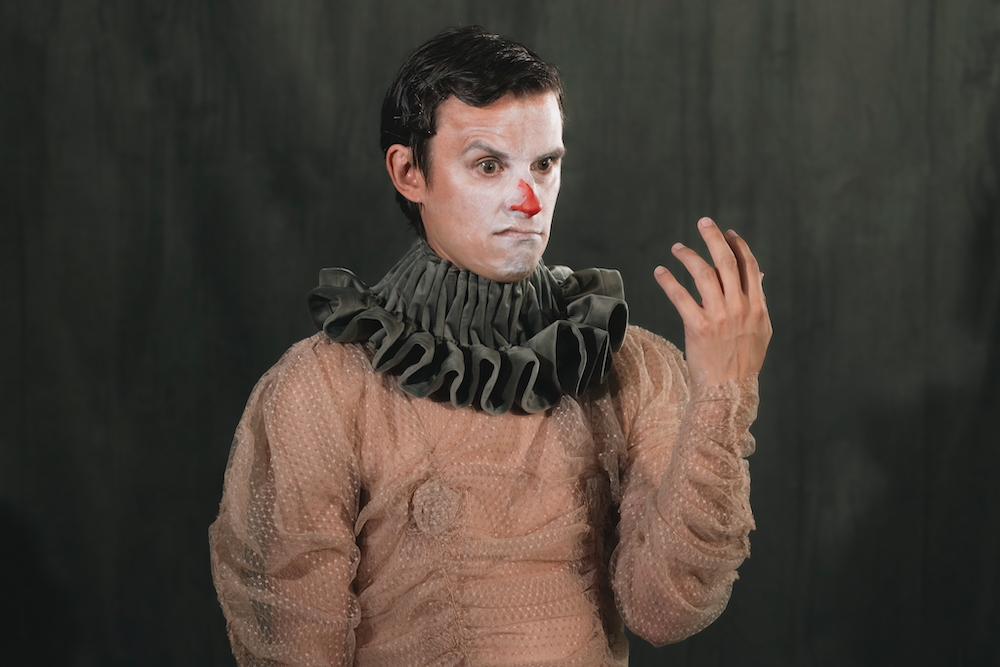
How was the idea for this performance, premiering at Moving in November, born?
During 2008-2010 I spent 2 intense years in Madrid, studying physical acting like clowning and bouffón, at the RESAD theatre school. But later I took the path of contemporary choreography and my education in physical acting faded to the background. I guess the logic of physical theatre felt hard to fit with the contemporary stage or at least I was looking for a very different mindset regarding my relationship to the audience and narrative. However after creating my own works for a while I started noticing that clowns and buffoons play a major part in the basis of my approach to performing, lurking in the sediments of my body. So this contradiction of the clown seeming ”unfit” with my choreographical practice started tempting me more and more. And also the idea of reclaiming it and circulating it through the bodily knowledge that choreography has given me.
It feels like an intriguing hijack, cutting the clown out from a place belonging to my past and placing it in the centre of what I’m busy with now. And anyway, it was a bit narrow-minded of me to think of the clown as unfit to a certain context since it is very hybrid and exceptionally layered – a character that transcends time and space. The idea to revisit this past practice of mine and to create a piece that draws from the clown and it’s variations has been bubbling under for a long time and I’m inspired to premiere it in Moving in November festival.
In The Tormentor, you are working with the character of the fool. Could you share more about this figure and the urge to explore it?
The fool is an incredibly rich figure. As a character, the red-nosed clown might seem stereotypical and even commercialized, but its origins branch out all around the world to traditions and carnivalistic events that have existed simultaneously—usually situated at turning points in nature’s cycle or in human life. One could follow the red nose far back in time; according to some interpretations, it could even refer to Dionysus, with their face reddened by wine and feasting. The fool has various incarnations, but it is usually a character that acts in reverse, shaking and questioning societal norms—or, in fact, anything that seems fixed or ’set.’
In art, one of my main references has been Mikhail Bakhtin’s writings about the carnival and the grotesque. Especially his thoughts on the grotesque body have resonated in my choreographic works—a body that is in the process of being born and dying at the same time: a porous body that, as opposed to something normative and set, transforms through time—amorphous, decaying, eating, and shitting. The fool is situated in the realm of the grotesque—it draws directly from the body’s physical layers, history, and raw vitality.
For the research of this performance, you visited former teachers of yours, but also artistic practices that you have studied. How does this reflect into the performance?
In March I spent two weeks at Tavernes de la Valldigna, Spain with Andrés del Bosque, a Chilean clown, actor and director who was my teacher at Madrid almost 20 years ago. He has his roots in Chilean circus clownery and political theatre and brings a very rich knowledge of the clown’s role as ”sacred” through its origins in ancient rituals.
In Finland my mentor is theatre director Taina Mäki-Iso who is a pioneer in Finnish clowning and who has studied e.g. with the clown master Philippe Gaulier (actually this is where Taina and Andrés share roots). She was the first person who introduced me to physical theatre and her support throughout this exploration has been priceless and a lot of fun.
Going back to physical theatre practices has reminded me of the element of ”play” that I often forget, but which is quite crucial to me when working with the poetics of the body. There is a quality of chaos and intuition in this work, but the chaos comes from a multitude of bodies emerging throughout my career, including clownish corporealities that weirdly seem connected to historical fools and jesters. I feel it has been important to form a dialogue with makers from another generation who possess vast knowledge of the traditions I am engaging with, even though I’m filtering them through my choreographical practice. Of course, differing performative approaches bring occasional friction, but in this piece, those are the most juicy moments for me.
Mikko Niemistö: The Tormentor
Mad House & Reality Research Center 8.11.2026 16.00 / 9.11.2026 19.00 / 10.11.2026 16.00 & 21.00
Soup Talk 10.11.2026 12.00 @ Caisa
Choreography and performance: Mikko Niemistö
Sound design: Johannes Vartola
Lighting design and set design: Sofia Palillo
Costume design: Siru Kosonen
Puppet: Siru Kosonen
Clown and buffón mentor: Taina Mäki-Iso
Artistic exchange and exploration of the clownesque with: Andrés del Bosque
Outside eye: Maya Oliva
Technical Support: Teo Lanerva
Thank you! Eero Alavus,Tatu Hämäläinen, Hanne Jurmu, Katarina Lindholm, Maria Saivosalmi, Sointu Saraste, Markus Schaffter
Production: Mikko Niemistö and Soili Huhtakallio
Co-production: Moving in November
Residencies: MDT, Ehkä-production & Contemporary Art Space Kutomo
Supported by: Kone Foundation, Albert Saloranta Foundation
Photo: Katri Naukkarinen
In collaboration with: Mad House Helsinki & Reality Research Center