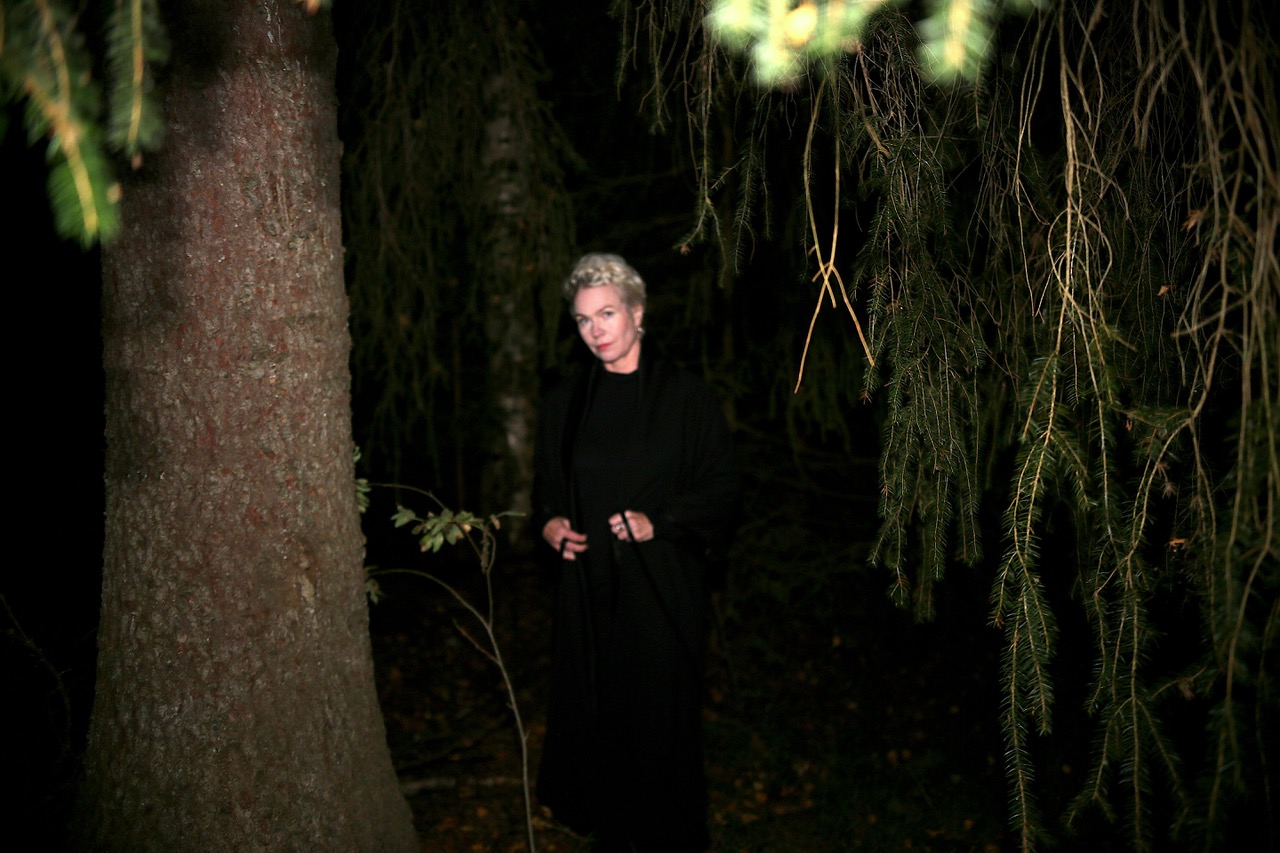
Kerstin Schroth: Maija, you are Moving in November’s first researcher-in-residence, what will you be working on during the festival?
Maija Hirvanen: I’ll be working on fungal choreography. I’ve developed fungi-like performance for several years and currently I’m also doing doctoral research on this area at the University of the Arts/Theatre Academy. Fungal, in this work, means quite a few things. I look at the connections of practicing choreography and working with fungi and how learning about another life form’s way of being affects one’s conception of choreography and artistic ways of working. It is all about ways of being, mysteries, ecologies and expanding the area of choreography and performance, but also about process based ways of understanding the world and phenomena.
I will appear with my portable researcher’s table at different times and places during the festival, inviting encounters and co-existence. I set up open-for-all group readings of Mycoscores / Choreospores, a choreographic method I’ve been developing for quite some time, with the intention of opening new relations and ways of approaching our entangled, multilayered contexts. I will share a few findings of my research and artistic practice at the Choreographic Convention, as a Mycochoreography Salon.
As is known by now, fungi are one of the kingdoms/queendoms of life, alongside plants and animals. They live in our environments in multiple forms; in our bodies, in the air, in the ground, mostly in forms invisible to the human eye. Over the last decade, the significance of fungi to all life, and their ubiquitous presence everywhere has risen to the awareness of many, thanks to the amazing books, films and other forms that have popularized the neglected megascience of mycology, and above all the dedicated mycologists and fungal enthusiasts, who have done decades of trailblazing work with and for the fungi. I remember the fungi were not this cool in the 1990s or the 1980s of my childhood, as I was dancing away secretly with the Amanita Muscarias, rotten boletes and star reindeer lichens in the woods near my home.
By gathering, observing and cultivating fungi I’ve learned about circular conceptions of time, about timing, about co-dependency, about richness of aesthetics and dramaturgies of surprise. Simultaneously, I’ve learned about similar kinds of notions in my work with choreography.
I’ve made performances, performance texts and scores, artistic publications and collective art laboratories, aiming at experimentation. At the same time, I’ve been a mycophile since I was a small child. Over the years, my extensive practice of foraging has expanded toward cultivating fungi and other areas of fungi related practices. I’ve studied mycology and its subareas for a decade and in the context of my doctoral research, this practice is deepening and taking new directions specifically in relation to artistic work. I’m consciously bringing working with fungi and choreography into interaction, and learning from this process. In my research, choreographic and fungi-related practices are parallel ways of understanding human and more-than-human bodies, in co-creation.
My research practice is guided by the aspects of imagining, relationality and transformation, which have followed me in my artistic work for a long time. These aspects act as keys — or rather, as hyphae, living threads — for my Moving in November research period.
I will take part in the festival as an artist and researcher, in a fungal way. I will look, suggest, discuss, encounter and write in a fungal way. I understand the festival as a context, in which my research takes place; an ecological milieu and a substrate of my research practice and artistic work.
The findings of the residency period are to emerge during the festival, not beforehand, but at the moment I’m planning concrete situations, forms and circumstances for the period of research within Moving in November.
Kerstin Schroth: You are specifically interested in being in residency with us because of the overarching social aspect of the festival: bring people together and creating temporary communities. How does this connect with you artistic practice and your doctoral research?
Maija Hirvanen: One of the key aspects of my current research is relationality and how it manifests in the realm of choreography and performance. I’m investigating, in one part, social-ecological choreography. One of the aims of social choreography is researching various ways of suggesting relations in a particular context, and arranging circumstances for relations to emerge. In my proposal of fungal choreography, human bodies can’t be thought of or framed as separate from their environments; rather, we are constantly reforming in a complex interaction, out of which different kinds of crystallisations, transformations and momentums appear. My premise is that the limit of our individual human body is not defined by the edges of our skin, but we sense, become conscious, spread out and entangle with our environments and with other kinds of bodies – affected and moved. Our bodies change constantly in various molecular dances, influences and forces.
For the fungi – this is what I assume – individuality is not central in the way it is to human-animals. For us, the experience and politics of individuality are important, but the concept of individuality gets confused with individualism and its current forms of self-centeredness. From the principle of constant movement – life’s basic starting point – and that of relationality, individuality is a kind of illusion. Working with the connections of fungal life and with human bodies reminds me of this, corporeally, epistemically and conceptually.
As a researcher in residence, I place myself in curious and open positions to cultivate the aspects of relationality in social-ecological choreography, particularly through the fungal lens. For me, this means learning from the fungi’s sometimes mystical way of co-existing and co-developing particular, multispecies conscious aspects of choreography out of this process.
Fungal choreography takes place through corporeal figuration, by means of somatic, figurative attunement. It works as a pathway for strengthening, acknowledging and renewing multispecies connections and for taking these connections into account as a part of the milieus of various choreographic events. It awakens our curiosity towards the connections in between the life forms of the human and the fungi. This kind of choreographic approach also alters social relations by awakening our collective capacity for corporeal imagination. In this way, the choreographic practices developed within my research act as a substrate for situated, particular relations, movements, experiences and knowledge.
Kerstin Schroth: Two years ago, during Moving in November, you presented your book: MYCOSCORES and did one-to-one readings for audience members of the cards this book contains. I am curious about your experience with these readings and how these experiences nourish your research?
Maija Hirvanen: Mycoscores / Choreospores is a choreographic method I have developed over the years through my long-term artistic work and my practice with fungi. One of the forms through which I work with the method is an artistic publication consisting of a set of 31 cards and an accompanying booklet, published in 2023. Each of the cards presents a score, in a text based form, that is stemming from the method’s framework and offers a different starting point for dancing, composing, weaving social connections, and exploring performativity. The title of each score is a verb that could be playfully considered both fungal and human, such as breathing, connecting, decaying, entangling, pushing, shape shifting and waiting. The scores propose particular instructions for working with more-than-human attunement and the human body as an interconnected, sensitive entity.
At the Moving in November Festival 2024 I made playful, performative readings with and through the Mycoscores / Choreospores cards for one person at a time. It is another way of activating the score cards – utilizing them as initiators of encounters, discussions, sharings, explorations. A ticket to the reading included a copy of the publication and the reading, and an additional fungi-related item the content of which is a secret of course. I remember sitting in the rooms reserved for the one-to-one readings at the Cultural Centre Caisa and Kiasma Museum of Contemporary Art, as the person who had booked a reading entered. Some were early, some a little late, some with a child, some holding an umbrella or a sandwich.
Every reading lasted for 30 minutes and was structured by a particular method, framed by the cards. Nevertheless, every session was different. The direction of the situation depends on the interests of the person joining, the weather, coincidences, the dialogue that takes place between the person and me. The readings are one of the practices I’ve already discovered within fungal social choreography. Within them, I utilize my knowledge of fungi and of choreography as interpersonal movement, and activate my experience with an awareness that the person accompanying me in the situation has their own memories and understanding in relation to all of it, and more. The person being read to leaves the session with a Mycoscores / Choreospores copy in their hands, and with a new experience.
In fact, I will continue working with the Mycoscores / Choreospores as the researcher in residence, and will activate them in new ways again.
See you at Moving in November!